
Why Diving Boards Are Disappearing from Modern Inground Pools — What Southern California Homeowners Should Know
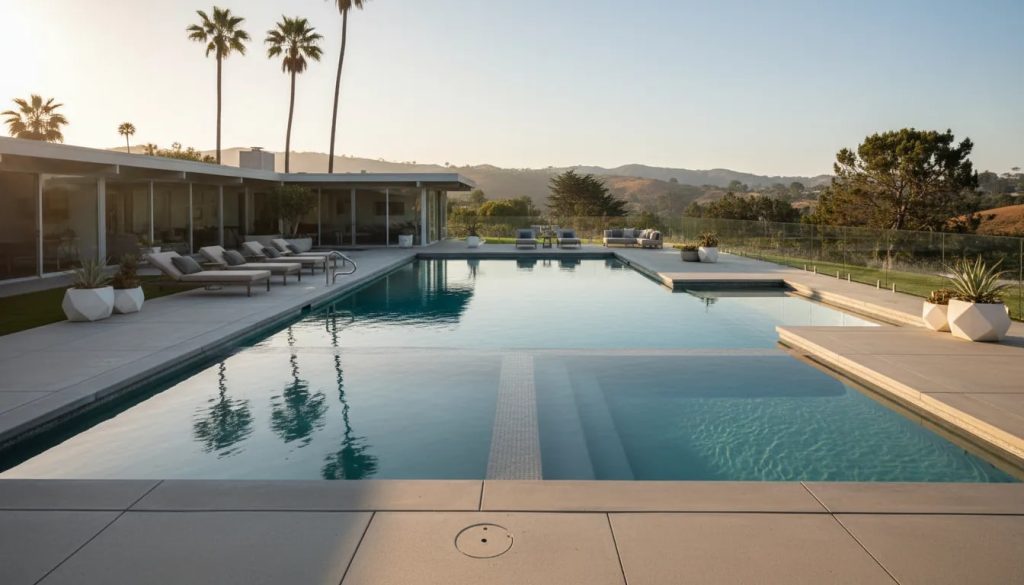
A diving board may seem like a classic backyard feature, but it is becoming uncommon in new pool designs. Homeowners, designers, and contractors increasingly favor shallow play areas and safer amenities. This article explains the practical, regulatory, and design reasons behind that shift and gives concrete guidance for families considering a diving board on a custom concrete pool in Southern California.
What a diving board requires: space, depth, and structure
Installing a diving board is not just a matter of bolting a board to a deck. It affects pool length, depth profile, structural design, and site layout.
- Minimum pool length: Typical guidance for a one-meter (standard backyard) diving board is a pool length in the high 30s, commonly cited as about 38 to 40 feet from the board end to the opposite end to provide a safe approach and landing zone. Narrow suburban lots often cannot accommodate that footprint without sacrificing usable backyard space.
- Required depth: A diving board installation normally requires a deep end of roughly 8 to 9 feet or deeper. That depth must be built into the shell during construction, which affects excavation, rebar layout, and shotcrete placement for a concrete pool.
- Structural and foundation impact: The deep end and board mounting must be engineered into the concrete shell. Adding a diving-capable deep end after the fact is expensive and often impractical.
Safety concerns and injury statistics
Safety is the dominant reason many homeowners and builders avoid diving boards. Diving-related injuries — including head, neck, and spinal trauma — can occur when a diver hits the pool bottom or side. Over recent years, pool owners, insurers, and community associations have become more risk-averse, prompting many to omit boards from new designs or remove existing ones.
Because of safety risk, designers now favor features that reduce the chance of accidental injuries while still delivering fun and variety for families.
Why modern diving boards feel stiffer
Manufacturers now build boards with reduced flex. That change results from increased safety standards and liability concerns. A stiffer board reduces the chance of mis-timed spring action that could cause awkward launches or loss of control mid-air. The trade-off is less bounce and a qualitatively different experience than older, more flexible boards.
Insurance, HOA, and local regulations: what to check before adding a board
Adding a diving board can affect homeowners insurance and HOA rules. Insurers may raise premiums, add exclusions, or decline coverage for properties with high-risk amenities. HOAs sometimes prohibit elevated play features or require additional liability measures.
Before deciding, homeowners in Southern California should follow this checklist:
- Contact the insurer early — Request written confirmation of how a diving board affects coverage and premiums.
- Check HOA rules and CC&Rs — Confirm whether a board is allowed and what safety features are required.
- Confirm local code and permit requirements — Some municipalities have standards for diving installations or require specific safety fencing and signage.
- Obtain engineered details — A pool contractor or structural engineer should supply mounting and foundation specifications for the board.
Why modern pool design trends favor shallow, social spaces
Behavioral trends drive pool layout choices. Many homeowners use pools primarily for socializing and play rather than competitive swimming or frequent diving. That leads to features that maximize usable shallow space:
- Sun shelves and tanning ledges provide a wide, shallow area for lounging and supervising children.
- Expanded play zones with shallow swim platforms and seating steps make the pool more versatile for mixed-age families.
- Integrated spas, benches, and swimouts create social islands that keep guests in one comfortable area rather than dispersing across a large deep end.
Alternatives to a traditional diving board
Homeowners who want excitement without the liability of a diving board have several safer options that fit modern pool designs and smaller lots.
- Pool slide with engineered run-out — Slides can be designed with a controlled descent and landing area that meets safety standards.
- Dedicated diving well — In luxury or large-scale projects, a separate diving well provides deep water for diving while keeping the main pool shallow.
- Jumping platform at low height — A low platform reduces fall height and the risk of severe injury while still offering play value.
- Interactive water features — Bubblers, spray jets, and shallow splash areas keep kids engaged without depth risks.
Concrete pool considerations: why a builder like Werth Builders often recommends skipping a board
Concrete (gunite) pools give the greatest flexibility for custom shapes and depth transitions, so they can be engineered to include a safe deep end or diving well. Even so, many experienced builders and contractors advise homeowners to prioritize the features they will use most.
When diving boards are added, they increase excavation scope, rebar labor, and structural requirements for the deep end. For many Southern California families, that cost and the required long pool length reduce space for other components such as an outdoor kitchen, spa, or pavilion — amenities that deliver more everyday value.
Homeowners exploring concrete pool construction can review services and design options at custom pool construction and learn how a builder integrates play zones, spas, and outdoor kitchens into cohesive backyard plans. For broader company information, see Werth Builders. Outdoor entertaining builders frequently pair pools with cooking areas; homeowners may find ideas at outdoor kitchens.
How to decide: a practical homeowner checklist
Use this step-by-step decision guide when evaluating whether to include a diving board on a concrete pool project.
- Inventory household users — If the pool is primarily for small children and frequent social gatherings, a large shallow play area usually offers more value than a diving board.
- Measure available backyard space — Confirm if the lot can accommodate a 38–40 foot pool length and a deep-end excavation without compromising setbacks or landscaping goals.
- Estimate costs and trade-offs — Ask builders for separate line items for the deep end and board installation to compare against other features like an outdoor kitchen or spa.
- Talk to the insurer and HOA — Get written guidance on insurance implications and HOA restrictions before final design decisions.
- Prioritize safety upgrades — If a diving board is chosen, include features such as compliant fencing, self-latching gates, pool covers, and pool alarms to reduce liability exposure.
Pitfalls and common mistakes to avoid
- Sizing by feel — Designing a pool around an assumed board requirement without confirming exact dimensions and depth creates costly redesigns.
- Skipping insurer or HOA conversations — Failing to check coverage and rules can lead to surprise denials or higher premiums after installation.
- Under-engineering the mount — Boards attached without proper structural backing risk failure and severe injury; always require engineered mounting details.
- Ignoring actual family use patterns — Many homeowners discover that a deep end goes unused while shallow areas get the bulk of activity.
Summary — When a diving board makes sense and when it does not
A diving board is appropriate when the property can safely accommodate the necessary pool footprint, the household intends to dive regularly, and insurance/HOA considerations are satisfied. For many Southern California homes, priorities such as entertaining space, shallow play areas, and complementary outdoor features deliver more day-to-day enjoyment and lower long-term liability.
Concrete pools offer the most design flexibility, but design choices should align with realistic use, safety, and neighborhood rules. Homeowners planning a new inground concrete pool can benefit from early conversations with a qualified contractor and their insurer to make an informed choice about diving boards and alternative features.
Are diving boards legal in Southern California and do they require permits?
How deep does a pool need to be for a diving board?
Will a diving board raise homeowners insurance?
What are safer alternatives to a diving board?
Ready to Transform Your Backyard?
Get a free consultation and estimate for your custom pool, spa, or outdoor living project. Serving Huntington Beach & Orange County.