
Gunite vs Shotcrete: Choosing the Best Method for a Concrete Inground Pool in Southern California
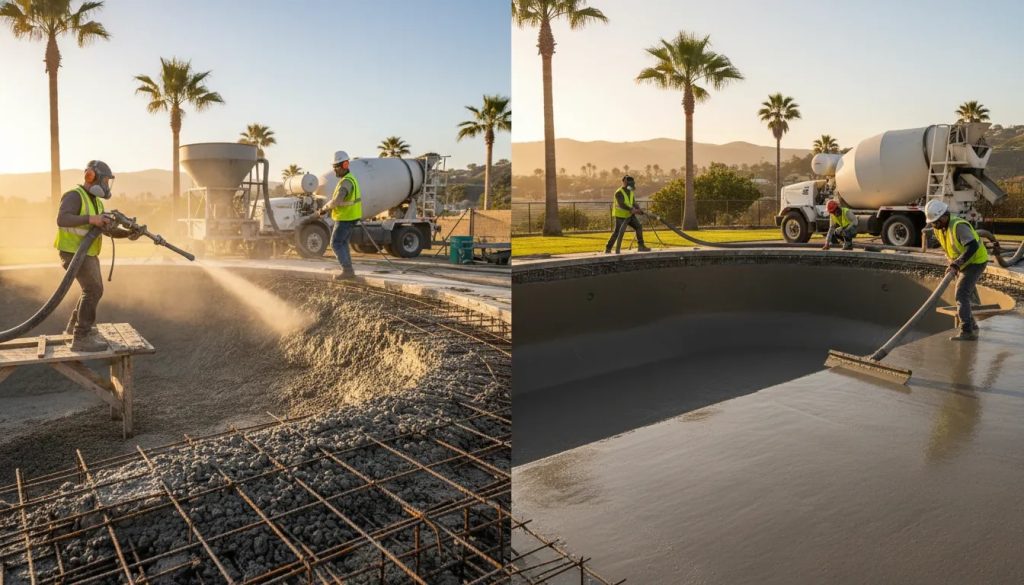
A concrete inground pool can be built using two spray-applied methods commonly referred to as gunite and shotcrete. Both produce durable, highly customizable pools that suit Southern California lifestyles, but they differ in how the material is mixed and placed. This article explains the technical differences, practical pros and cons, local considerations for Orange County and coastal communities, and a homeowner checklist to choose the right process and contractor.
What are gunite and shotcrete?
Gunite is a dry-mix process. Cement, sand and dry additives are fed through a hose to a nozzle where water is introduced at the tip. The mixture is pneumatically projected at high velocity onto the pool walls and floor and compacts on impact.
Shotcrete is a wet-mix process. Concrete (wet mix) is prepared before placement and pumped through a hose to the nozzle, then fired at the surface under pressure. Both methods rely on impact consolidation to form a dense shell over reinforcement.
Key technical differences
- When water is added: gunite mixes water at the nozzle; shotcrete is mixed with water before pumping.
- Equipment and placement: gunite uses a dry-mix gun and the operator controls water at the nozzle; shotcrete uses a concrete pump and usually requires a different nozzle and pump setup.
- Rebound and waste: both have rebound (material that bounces back), but dry-mix gunite can produce higher rebound in inexperienced hands. Skilled crews minimize waste in either method.
- Consistency and quality control: wet-mix shotcrete allows lab-controlled batches and consistent slump; gunite requires careful on-site water control and skilled nozzle operators to maintain quality.
- Finish and shaping: both can achieve complex shapes and proper compaction; gunite can give installers fine local control during intricate work, while shotcrete offers batch consistency for large placements.
Which is stronger: gunite or shotcrete?
Strength depends on mix design, water-cement ratio, compaction, curing and reinforcement, not the name alone. Properly mixed and placed shotcrete and gunite can meet the same compressive strength specifications. Homeowners should request the engineer’s structural specifications and ask for compressive strength test results or mix designs for verification.
Pros and cons for homeowners
Gunite (dry-mix) — advantages
- Greater nozzle control for complex shapes, overhangs and tight details.
- Immediate placement without relying on batch delivery timing.
- Commonly used by traditional pool builders and familiar to many local crews.
Gunite — drawbacks
- Requires skilled nozzle operator to control water content and minimize rebound.
- On-site water control variability can affect consistency if not managed well.
Shotcrete (wet-mix) — advantages
- Batch consistency from a concrete plant or onsite mixer helps achieve predictable slump and strength.
- Faster large placements because the pump moves wet mix continuously.
- Often better for thick structural pours where uniformity is critical.
Shotcrete — drawbacks
- Site access and pump logistics can be limiting in tight urban yards.
- Slightly different finishing approach and still requires experienced nozzle operators for dense consolidation.
Cost and timeline considerations
Material costs for gunite and shotcrete are generally comparable. Labor, site access, and project complexity influence final pricing more than the spray method. Shotcrete can be quicker for large continuous placements, while gunite may be marginally faster on smaller, highly detailed builds if the crew is experienced.
Typical pool construction timeline (approximate, depends on permits, site conditions and finishes):
- Design and permits: 4 to 8 weeks
- Excavation: 1 to 3 days
- Rebar and plumbing: 1 to 2 weeks
- Gunite or shotcrete placement: 1 to 3 days
- Curing and finish (plaster, tile): 1 to 3 weeks
Southern California and coastal factors to consider
Homes in Orange County and coastal communities have unique factors that affect concrete pool design and construction:
- Soil and groundwater: clay, sandy soils or high groundwater near the coast may require engineered footings, deeper excavation, or hydrostatic relief systems.
- Salt air and corrosion: specify corrosion-resistant steel, epoxy-coated rebar or proper concrete cover where salt exposure is likely.
- HOA and coastal permits: coastal management and HOA rules may affect setbacks, drainage and allowable elevations. Early permit review avoids delays.
- Local code compliance: ensure engineered plans meet local building codes and the Contractors State License Board (CSLB) requirements when hiring a contractor.
How to evaluate contractors and choose the right process
Because both methods produce quality results when executed correctly, selecting an experienced, licensed contractor matters more than choosing a method by name. Homeowners should use this checklist when vetting pool builders.
- Verify CSLB license and insurance. Confirm current license status and adequate insurance coverage.
- Ask for references and photo documentation of completed gunite or shotcrete pool projects with similar complexity.
- Request mix designs and structural plans from the project engineer and confirm compressive strength targets.
- Ask about nozzle operator experience and company crew training—placement skill is critical.
- Confirm testing and quality control such as slump tests, cylinder breaks and proper curing practices.
- Confirm warranty and post-construction support for structural issues and finishes.
- Review access plan and equipment needs for shotcrete pumps or gunite rigs to ensure minimal disruption.
Common misconceptions
- Myth: Shotcrete is always stronger than gunite. Strength depends on mix, water-cement ratio, consolidation and curing, not the method alone.
- Myth: One method is “newer” or “better”. Both are established industry techniques with decades of performance when applied correctly.
- Myth: Concrete pools are low maintenance. Concrete pools are robust and highly customizable but require periodic surface maintenance, chemical balancing and occasional refinishing depending on finish choice.
When to prefer one method over the other
Choose based on site logistics, crew expertise and project goals:
- Prefer gunite for tight yards, tricky shapes or when an experienced nozzle operator provides better control on details.
- Prefer shotcrete for large, uniform structural pours where batch consistency and pump efficiency are priorities and site access for pump and mixer is available.
- Focus on contractor capability. A skilled crew using either method will produce a safe, long-lasting concrete shell.
Practical next steps for Southern California homeowners
- Collect local references and view completed projects with similar design features.
- Ask for engineered structural plans and a written specification that identifies whether gunite or shotcrete will be used and why.
- Confirm permitting plan and timeline with the contractor and local building department.
- Discuss coastal considerations like rebar protection, drainage and hydrostatic relief if applicable.
- Compare two or three bids that include the same structural spec, finishes and warranty terms rather than comparing method names alone.
For homeowners planning a full outdoor living transformation, concrete pools are often the best long-term investment because they allow unlimited shape, depth and feature customization. Working with an experienced local contractor ensures the chosen placement method aligns with site constraints and performance expectations. Many Southern California projects combine the pool with outdoor kitchens, pavilions and hardscape to maximize value. See examples of how a custom pool ties into broader outdoor living work at Werth Builders outdoor kitchens and learn more about custom pool construction at custom pool design and construction.
Learn more about the company and its approach to inground concrete pools at Werth Builders.
Summary — pick the contractor, not the label
Gunite and shotcrete are both reliable methods to build a durable concrete inground pool. The meaningful difference for homeowners is the contractor’s experience, the engineered specification, and how well the team controls mix, placement and curing. In Southern California, planning for soil conditions, coastal exposure and permit requirements early in the process gives the best chance of on-time delivery and lasting performance.
Frequently asked questions
Is one method more expensive than the other?
How long does the concrete shell need to cure before finishing?
Which method is better for complex shapes like vanishing edges or grottos?
What should homeowners ask contractors about quality control?
Does coastal salt air affect the choice between gunite and shotcrete?
Ready to Transform Your Backyard?
Get a free consultation and estimate for your custom pool, spa, or outdoor living project. Serving Huntington Beach & Orange County.